01 The wall

More code than anyone can read.

Review is the new bottleneck. BranchEagle is a pull request or merge request review tool helping humans to provide a good experience of review: risk order, proven mechanical folds, questions instead of verdicts, and one review you post to GitHub or Gitlab.

Agents open pull requests faster than your team can read them. Spending simply more reviewing time will find its limits, especially when the size of pull requests is increasing as well.

02 The fork

Why not just let the agents review and merge?

This is called dark factory or Software Factory: It is a rising trend in software industry, and for some companies and products this works extremely well. But this is not true for all kind of products and companies. Even though this might be a valid approach for a certain company, this is a path to go. The CI, the process and the harness must be trimmed to this. BranchEagle can help you on this track. Where BranchEagle shines is keeping the employees in the loop (Human in the loop) and accountable for the code. This is not black or white. There is plenty room in between, and some industries like medical even strictly require additional human proof.

Kinds of change that keep passing will get less of the team's time Coming soon. One-way doors always stay with a person.

03 The eagle's view

Riskiest part first.

Auth, migrations, dependencies, CI and deleted tests rise, plus whatever your team's rules flag, like money math. Renames and moves fold away, but only after a deterministic check proved them purely mechanical.

04 Questions, not verdicts

It asks. You decide.

The guide never calls the code fine: it asks about the choices the agent took on his own, and your disagreement becomes a comment on your prefferd coding platform.

05 The prevention loop Coming soon

Every catch becomes a check.

BranchEagle will help you finding patterns which occur more often and propose fixes. Either additional deterministic CI checks or adapting the harness. With this the manual effort will be less over time.

06 The trust ladder Coming soon

Less to read, run by run.

Every review leaves a local record of what was flagged and where people commented. The direction: kinds of change that keep passing untouched will get less of your time, and the relevant changes get your attention.

  1. Guided review Available
  2. Trust record Collecting View coming soon
  3. Catch to check Coming soon
  4. Sample merged PRs Coming soon
  5. Earned autonomy per kind of change Coming soon
  6. One shared company instance Coming soon

Three people, one pull request.

Senior developer

A review that starts where it matters.

  • One command opens the PR in a local web UI. The diff is in the middle; the guide stays closed until you press g.
  • Units come highest attention first, each with the reason it was flagged. Confirm a rename once and its hunks collapse everywhere.
  • Keyboard all the way, and drafts survive the author's next push. With --ui, screenshots of the touched screens sit next to the code.
  • Re-review only what changed since your last pass Coming soon
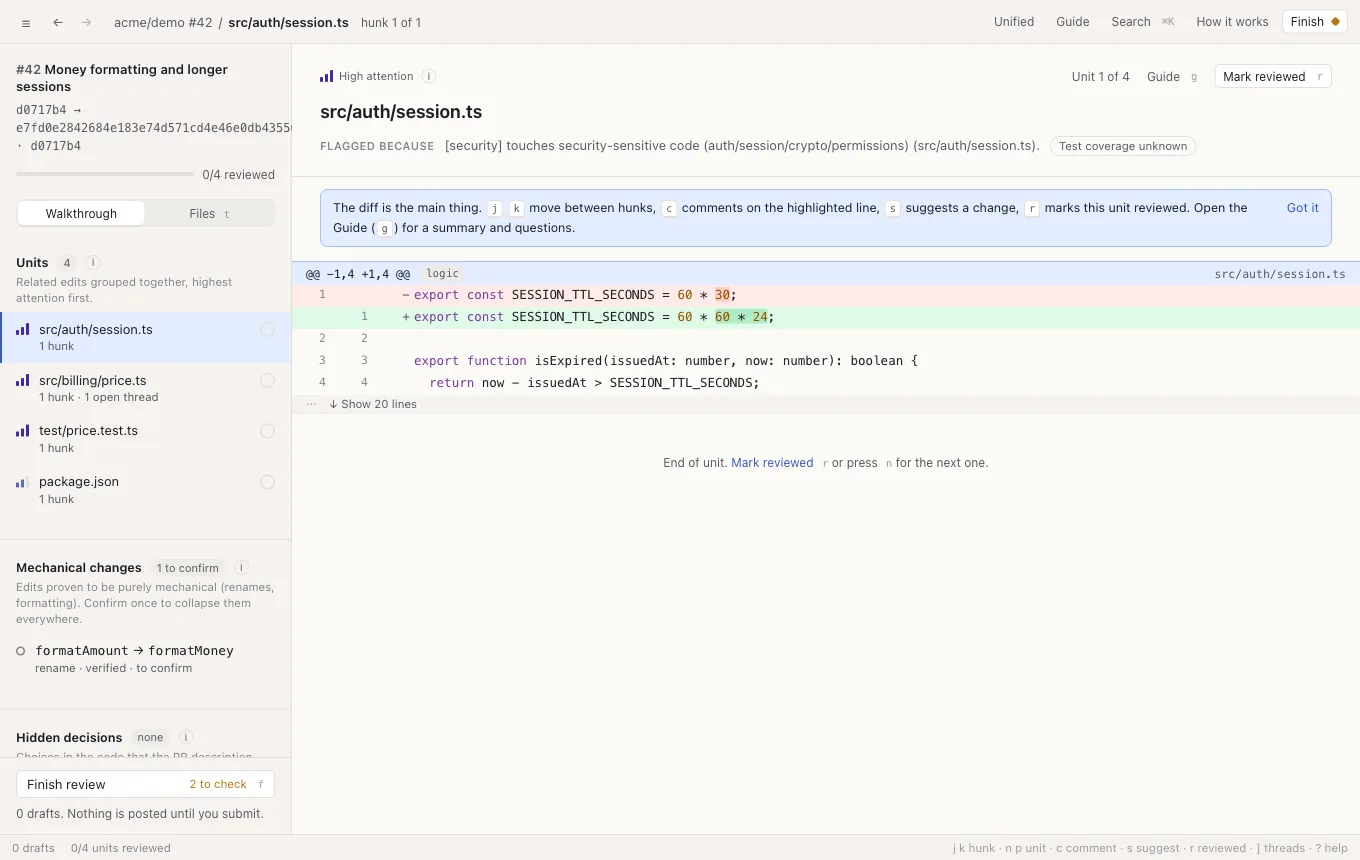
The BranchEagle review screen: units on the left ordered by attention, a session timeout change in the centre flagged as touching security-sensitive code, and a rename listed under mechanical changes, verified and waiting to be confirmed.
A unit flagged for touching session code. The rename below it is verified and waits for one confirmation.

Tech lead

It fits the flow you already have.

  • The PR stays on Github/Gitlab. What gets posted is one normal review from the person who did it: line comments, suggestions, replies, resolves and their verdict.
  • The Finish page shows the exact payload. If it no longer matches the head, submit is refused.
  • Your domain rules live in .review/rules.json, reviewed and committed like code. brancheagle init drafts them and never writes the real file.

Gates in .review/config.json, each off, warn or block

GateDefault
The PR head moved since the review was builtblock
A draft is empty, or anchored outside the diffblock
A comment-only review with nothing in itblock
A high-risk unit isn't marked reviewedwarn
A mechanical change is neither confirmed nor rejectedwarn
A choice the code made is neither agreed with nor discussedwarn
Behaviour changed without a test, and nobody answeredwarn
CI is failingwarn

CTO

Review is the new bottleneck. Skipping might cost even more in the long run.

  • Generating code got cheap; checking it didn't. Unread pull requests pile up or get rubber-stamped.
  • Letting agents merge unread gives you a dark factory: code that nobody at the company has read or can answer for. Not every team trusts agent output that far yet, and plenty never want to.
  • BranchEagle works for the reviewer. A person stays accountable and keeps knowing the codebase, and the review gets cheaper and more honest today.
  • You decide how far up the trust ladder to go, and you can stop at any rung. Fewer full reads per kind of change, as trust is earned, is the direction Coming soon
No BranchEagle cloud server.
Code stays in your company and goes only to Claude (other harness will follow soon), through their own claude login.
No API keys.
Github and Githab access goes through the reviewer's gh or glab.
Cost you can see.
Every model run is recorded with the cost claude reports. Depending on the diff size and repository size, one review costs about 1 - 5$ at Claude API costs in November 26.
Questions, on purpose.
Reviewers shown an LLM review first tended to focus on the code it pointed to (Tufano et al., 2024). So the guide asks, and stays closed until you open it.

What it will never do

  • Tell you the code is fine. It describes, asks, and shows what it isn't sure about.
  • Pick your verdict. Approve, request changes or comment. Nothing is pre-selected.
  • Settle the requirement without the author. Open questions go to the PR.
  • Hide code on a hunch. Folding needs a deterministic proof.

Questions a tech lead asks first.

What is BranchEagle?

A review tool for pull requests, written by people or by coding agents. It runs on the reviewer's machine, orders the change by risk, folds edits that a deterministic check proved purely mechanical, asks questions instead of judging the code, and ends in one normal review that the reviewer posts to GitHub.

Why review at all? Why not let the agents merge?

Merging unread code gives you a dark factory: software nobody at the company has read or can answer for. Not every team trusts agent output that far, and many never want to. BranchEagle keeps a person accountable and lets the team decide how far they want to trust the agents.

Does BranchEagle approve pull requests?

No. It never says code is correct, safe or fine, and it never picks or pre-selects a verdict. The reviewer chooses approve, request changes or comment, sees the exact payload, and presses Submit.

Where does my code go?

BranchEagle runs no cloud server for reviews. The code stays on the reviewer's machine; the diff and the ticket text go only to Claude, through the reviewer's own claude login. GitHub and GitLab are reached through the reviewer's gh or glab login, so the tool holds no API keys.

Github or Gitlab?

BranchEagle works with both.

What does it cost to run?

BranchEagle needs no API account of its own: the model runs on the reviewer's own Claude plan. Each run is recorded with the cost claude reports. On November 2026, one review cost about 1-5$ on the Claude API costs, depending on the diff size and repository size.

Read the risky part first.

npm install -g ./brancheagle-<version>.tgz

A private build for now: ask the maintainer for the current tarball. It installs without the npm registry and updates itself at most once a day, only when the signature and checksum match.

You need Node 22 or newer, git, and the claude CLI logged in, plus gh for GitHub pull requests.

Then: brancheagle <PR url> --repo /path/to/clone, or brancheagle main..feature --repo . for a branch range.